Showing posts with label Forces and Motion. Show all posts

Tuesday, 5 December 2017

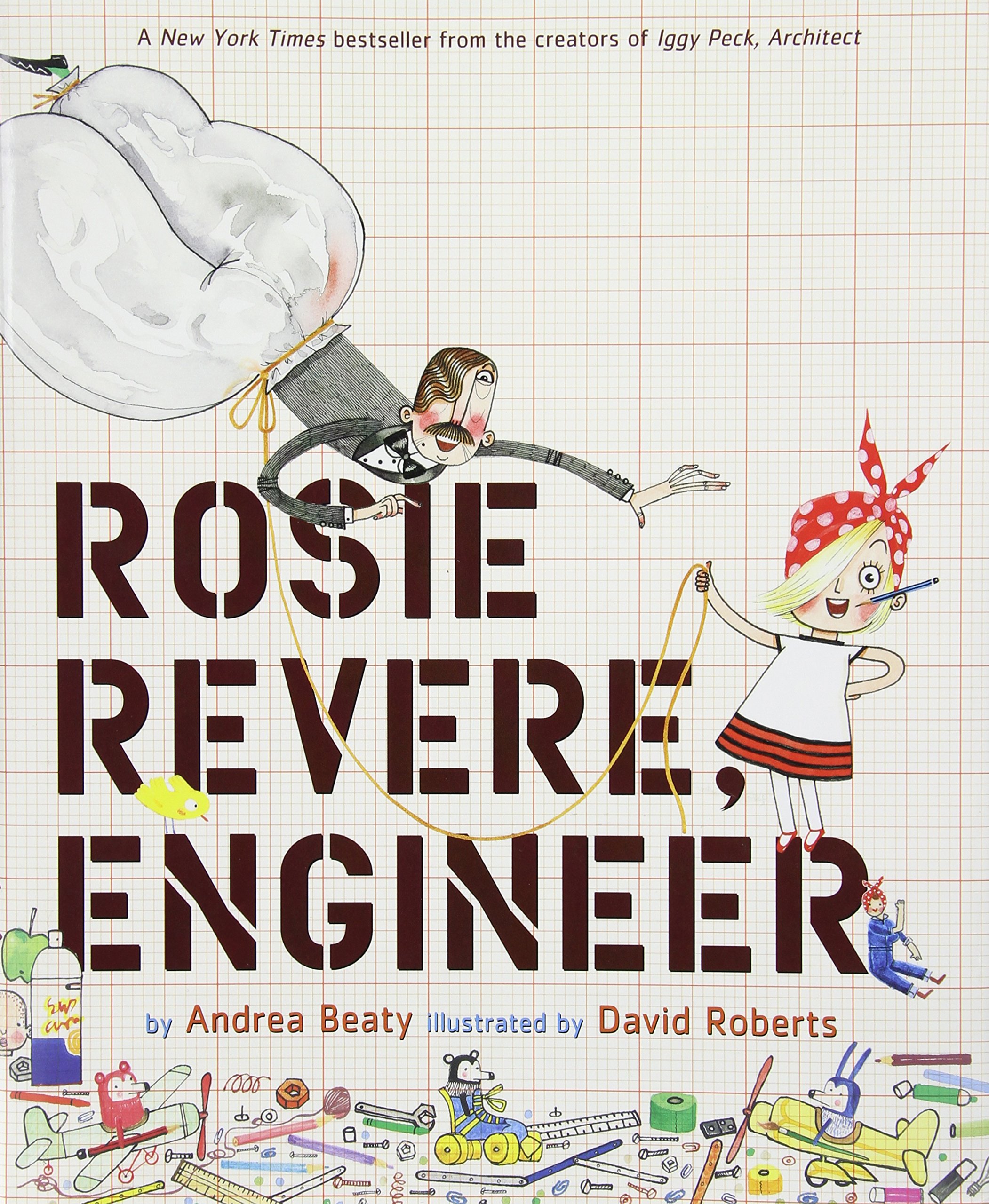
Rosie Revere, Engineer


As 4HR gets ready to go into the Makerspace to create our designs to solve real world problems, we read the story of Rosie Revere, Engineer. It is the story of a young problem solver, who doubts her engineering abilities.

We thought the author's message was:
Never quit!
Keep trying.
It is good to make mistakes, because then your brain will grow. 
Failure is a good thing.
She needs to fail to make her design better.

Let's keep these positive attitudes as head into the Makerspace.


Monday, 13 November 2017

Investigations into Motion & Energy

We are going to begin our experiments as scientists do: by asking questions! Let's watch this video, and record as a class: What do you notice? What do you wonder?


Our questions:
What are they?
Are they magnets? 
Is some one controlling them? Did they add anything? Did some one push them?
What makes them let go from the wood? Why is there a piece of wood?
Is the string bouncey/strong or weak?
Why did they change directions when they started? How do they change directions?
Why did they change patterns?
Why did the gaps get bigger?
Does it have to do with friction?
What kind of force does it have?
Do they weigh the same? Is the balls heavy or light or the same?

We then identified three variables to test: mass of object (example, a bowling ball vs a tennis ball), the release position (90 degree vs 45 degree) and the length of the string. We made predictions as to what impacted the movement of the pendulum (or the number of swings). Ask 4HR to find out what our results were!

Claim - Evidence - Reason

The release position affected the motion of the pendulum (number of swings) - no data supports this claim.

The mass of the fob affected the motion of the pendulum (number of swings) - no data supports this claim.

The length of the string affected the motion of the pendulum (number of swings)
-If the string is longer,
-The shorter the string, the more swings the pendulum completes. For example, when the string is 20 cm long, it completes about 18 swings. When the string is 38 cm long, it completes about 12 swings. But when the string is 15 cm long, it completes 17 swings. This information doesn't support our claim. We need to complete more testing to be more sure.

Tuesday, 7 November 2017

Sketchnotes


A new note-taking craze is going on! Yes, a craze about note-taking. It is called Sketchnotes. On Twitter, people share their sketch notes to provide the main idea and important details of information texts. Today, and tomorrow, we are going to share the main idea and supporting details about a simple machine.

Materials: Reading notebook, Cornell note-taking structure, pencil, and 1 laptop per group
Either with words or sketches, record the main idea and supporting details about your simple machine. Read as many sources as you can!


We are going to read texts on Big Universe. The log in instructions are as below.

Groups:
Lever - Tiago, Cathy, Nikita
Gear - Gregorio, Alice, Paige
Wheel and Axle - Siddharth, Anabelle, Carzen
Pulley - Jenna, Heathcliff, Allie
Wedge - David, Aadit, Aayushi
Inclined Plane - Estefano, Araxi, Aubrey
Screw - Sophia, Danny, Nathan

Before creating our Sketchnotes, we reviewed that TEXT, sketches, and organization are important! Here are our teams in action.


Thursday, 2 November 2017

Engineering Design Process

4HR will be tapping into our engineering expertise in this unit! Everyday we find solutions to ordinary problems. In this unit, we are going to help others by finding solutions to some extraordinary problems.

First, what steps do we need to take? Let's watch teams of engineers as they follow the design process.

Do you think we can identify the steps of the design cycle? Let's watch Nate solve a real life problem for his son. 

We are going to practice the first three steps of the design cycle by playing the game Disruptus. Get your thinking creatively hats on!

Thursday, 3 December 2015

Learning from a Physicist

Today 4HR spoke with Dr. Anthony Boyd via Skype. He is a physicist who works at a Naval Research Laboratory near Washington, DC. He talked with us about how he became a physicist, what his work day looks like, and answered our questions.


This is what we learned today:
- For a short time, we are stronger than gravity (lifting foot off ground)
- If there was no gravity, there would be no friction. The exception is in space when planets can rub against each other.
- If there is too much friction, we can't move.
- If there is no friction,  you would slide a lot.
- Friction always works in an opposite direction.
- There is a relationship between the moon and tides.
- Gravity is stronger than friction
- Gravity is an attractive force, so it pulls not pushes.
- We need to gravity to stay down.
- Even if the mass is different, in space objects falls at the same rate.
- You can fit more than 1,000 Earths inside Jupiter.
- There is only one kind of gravity. Sometimes it is safe, sometimes it is dangerous.
- People can't combine their strengths to push ourselves to space.
- Floods are connected to high tide and low tide.
- If there was no gravity, it would be hard to breathe because dust particles would stay in the air.
- We are pulling against the Earth, but since the Earth's mass is so much greater, the Earth pulls us.
- Momentum doesn't help us gain acceleration, but it does help us gain velocity.
- We need a lot of space to get out of the Earth's gravity.
- Distance affects gravity and mass affects gravity.
- When an object is falling, air resistance is pushing up against the object. When there is larger surface area, there is more air resistance.

Monday, 30 November 2015

Potential and Kinetic Energy to Simple Machines

4HR is investigating into How does the transfer of energy impact the motion of an object? In watching this video, we see how objects transfer energy from potential to kinetic energy. What happens as a result?


Later this week we will revisit this video, looking for simple machines. What do you already know about simple machines?

Tuesday, 3 November 2015

Applying Understanding of Friction


Today we are going to make predictions as to what surface would allow a skateboarder to travel the furthest. Let's play Friction Ramp to determine how friction affects are everyday lives.

Now let's watch Magic School Bus Plays Ball to find out how friction impacts sports.


Wednesday, 21 October 2015

Tuning in to Forces and Motion


Question: How could you move a ping pong ball one meter without using your hands?

Today 4HR delved into science. We designed, hypothesised, constructed, revised, tweaked, and tested our constructions. 

Key vocabulary we used were: weight, speed, momentum, gravity, slant, ramp, roll, bounce, incline, decline, launching, touch, friction, push, pull, hit, stretch, elastic, and rubbery.

Watch these videos to find out the thinking behind our constructions.


Popular Posts